Search

Tuesday, May 1st, 2012

Detroit: A Biography – A Review by Pete Saunders

[ You may remember Pete Saunders from his piece on the reasons behind Detroit's behind. I've long found Pete's insights provocative. I'm glad to report he is now blogging himself on his own blog called "The Corner Side Yard." Today he graciously shares another Detroit piece for us here, this time a review of Scott Martelle's new book, "Detroit: A Biography" - Aaron. ]

When I first got my review copy of Detroit: A Biography by Scott Martelle, I did the unthinkable: I started by reading the epilogue. I wanted to know right from the start where the author stood on the future of Detroit. Did his research suggest that revitalization is approaching, or even possible? Admittedly, my first reading of the epilogue seemed to be a repudiation of Detroit, that the city’s legacy has condemned it to failure.

Such is the defensive posture of a native Detroiter.

Reading the book from start to finish is an entirely different experience. Martelle constructs a well-detailed and finely crafted narrative of Detroit’s history, from its founding as a French outpost in 1701 to the present day (although Martelle glosses over much of the last decade or so, likely believing that the city’s die had been sufficiently cast). The book reads a lot like Detroit’s history – slow yet building over the city’s first two centuries; fast-paced and chaotic after the introduction and rapid growth of the auto industry; slower-paced, exasperated yet reflective as decline sets in. The historical narrative is interspersed with chapter interviews of native Detroiters who offer their insight on the past, present and future of the city. Martelle brings liveliness to the narrative, and his meticulous research is evident. It truly is a biography.

Detroit’s early history was really no different from its Great Lakes peers of Buffalo, Cleveland and Milwaukee, which all had varying degrees of French settlement, British rule and American growth. There is a lot of discussion about the French role in the creation of development patterns in Detroit – the ribbon farms – that led to a highly privatized riverfront. Once the French were gone and the British took over, there is similarly a lot of discussion about the contemptuous and oftentimes violent ways the British military elected to engage southeast Michigan’s Native Americans. The French and British did more to shape Detroit’s character than most realize.

Detroit, like the others, transitioned from regional trading center specializing in iron ore and lumber, to becoming a craftsman’s heaven building horse carriages, stoves and other metalworks. Interestingly, the author notes that late 19th and early 20th century Detroit was known as a top cigar-producing center. Who knew? But the number of skilled workers in the carriage-building and metalworks industries set the stage for the development of the “horseless carriage” industry in Detroit.

Of course, the singular power behind the founding and growth of the auto industry in Detroit is Henry Ford. Martelle is quick to make the well-known point that Ford did not invent the automobile; there were a number of “tinkerers” around the world, even others in Michigan. But he was in a position to take advantage of the local capital and skilled workforce to get the Ford Motor Company off the ground.

Martelle also alludes to the fact that as Ford the company grew, Ford the man’s flaws took root as pathologies to Detroit’s character. Ford’s aggressive business policies were well known and emulated; his racist, anti-Semitic and anti-Catholic leanings are acknowledged; his staunch anti-union sentiments led to bloody battles between the company and workers; his unwillingness to leave lasting institutions in Detroit, like an Andrew Carnegie in Pittsburgh, set the template for other Detroit industrialists.

The author paints a picture of Detroit breezing through the first third of the 20th century as the Silicon Valley of its time. Most people likely believed that economic growth alone would solve whatever underlying problems may exist, and there were many. Tensions grew as southern and eastern European immigrants competed for assembly line jobs with longer-established Scotch-Irish and German immigrants. Tensions further grew as African-American migrants moved up from the South for jobs, particularly during and after World War I.

Job competition intensified as the Great Depression emerged, and the rigid but informal segregation patterns in the city led to housing competition as well. The boiling tensions made Depression-era Detroit one of the most brutal places to be in America. The tremendous population growth of the previous decades was not supported by similar housing growth in Detroit, which made the city’s Depression housing shortage one of the most acute in the nation. The collapse of the auto industry at the same time made Detroit’s unemployment the worst in the nation. And the union battles of the time made the labor situation one of the most contentious in the nation.

This was Detroit’s second critical moment, after the explosive growth of the auto industry. City leaders and industrialists elected to let the economy sort out the city’s growing pains when things went well, and they again elected to let the economy do its thing as the city faced its first existential crisis. They were right – in the short term. Detroit emerged as the “Arsenal of Democracy” that built the armory that saved America and Europe. However, the lack of action by city leaders and industrialists had long term impacts that became evident after World War II.

It is at this point in the book that a fascinating set of what-ifs are implied by the author:

• What if there had been better early cooperation between the auto industry and unions?
• What if the industrialists like Ford had established enduring local institutions?
• What if the housing and overcrowding issues had been dealt with differently?
• What if Detroiters had had local representation (i.e., wards or districts) that could have represented the wishes of diverse residents and forestalled or diffused tensions?
• What if Detroit had become a defense contracting center that could’ve led post- World War II growth?

Unfortunately, Detroit’s leaders did not appear to be asking themselves these questions at the time.

Martelle then argues that Detroit’s path after 1950 is one of social and economic decline. Detroit becomes the epicenter of a Supreme Court legal battle on housing racial covenants; efforts by white residents to violently intimidate blacks from moving into all-white neighborhoods become commonplace. White flight has its start in Detroit well before it does in other major cities. The Auto Big Three (Ford, General Motors and Chrysler) decide to control more of the manufacturing process themselves and put the squeeze on auto parts suppliers. They begin to shift manufacturing jobs first to the suburbs, then to the South, then out of the country. Finally, the riot of 1967 begins to solidify the image of Detroit as being out of control.

The author is clear about the challenges that face Detroit today. Racial animosity and mistrust, usually couched in city vs. suburbs terms, is at a level virtually unmatched in the nation. Coleman Young, Detroit’s first black mayor, is often viewed as the wedge that widened the divide between white and black in Detroit. However, Martelle portrays him as someone who wanted Detroiters to directly confront its racial legacy, but was still nurturing the resentments of his segregated upbringing. Meanwhile, he paints many whites as believing that past indignities experienced by blacks are indeed past, and are resentful of the management of the city after they left it. But who can manage a city when jobs and middle class residents flee?

I read the epilogue again after reading the rest of the book. The second time around it read like a lament, a cry of sorrow and anguish for the city that gave us not only the automobile, but the idea of a stable middle class. Martelle clearly demonstrates that Detroit was uniquely impacted by national and global trends and policies, and that any city established in the same fashion would have suffered the same fate. Sadly, however, he says that the nation has left Detroit behind, and wonders if the nation will ever repay the debt it owes to the Motor City.

5 Comments
Topics: Urban Culture
Cities: Detroit

Tuesday, April 24th, 2012

First Time to the D by Alan Sage

[ This week I kick off another two part mini-series on a city from guest authors, this time Detroit. First up this travel piece from Yale undergrad Alan Sage. Next week Pete Saunders will check in with a book review - Aaron. ]

In the urban studies seminar I took last semester, our professor saved one day of class to tackle a surprise subject, one he would choose about a week before based on what the urbanist community was most heatedly debating at the time. So it came as no surprise when he sent out Philipp Oswalt’s opus on shrinking cities and announced we would be discussing Detroit.

Coming into such a wide field as urban studies, especially in a school where there’s no cohesive urban studies program but rather a smorgasbord of classes in various departments catering to specific interests, caused me a fair degree of trouble in deciding where to focus my attention. But the idea of shrinking cities captivated me immediately, as I imagine it has many other urbanists, perhaps because it is so simple a problem yet spawns infinite creative solutions. Ideas like urban farming appeal to my analytical side: there’s a poetry to the simple theory that as land value returns to the level at which it depends on what the land can produce rather than larger economic forces, its owners ought to appropriate its usage accordingly. Neighborhood stabilization techniques involving the eased acquisition of adjacent vacant properties, like the one Mayor Dave Bing is piloting right now, offer the same beautiful simplicity, harking to the idea of country estates, now economically possible given Detroit’s current land values.

But as these ideas captivated me, I realized that they might make sense theoretically but not practically; after all, while it’s great if a farm can bring fresh produce to a food desert, one doesn’t necessarily want to be walking by cornfields in inner-city Detroit after coming home from a late show, and who knows what kind of brownfield remediation expenses might be required. Filled with questions like these, I decided I would make a trip to Motown during spring break to see the much-discussed metropolis with my own eyes. After some attempts to convince my academic compatriots that the Motor City promised everything anyone could want in a college spring break, I realized I would be voyaging alone. But that was okay—for my French class, I had been watching a language learning program called French in Action, a story which centers on an amicable college student named Robert who takes a semester off from school to travel alone to Paris and “find himself.” I figured I would create my own version of French in Action, promenading on Woodward, Grand River, Gratiot, Michigan, and Jefferson: the Champs-Élysées equivalents of a city once called the Paris of the Midwest.

I landed at Wayne County Metropolitan around one in the afternoon on a hazy Tuesday, armed with a backpack and the address of Hostel Detroit, a quirky lodging in Corktown that seemed to be the perfect fit for my purposes. As my cab exited the Fisher Freeway onto Rosa Parks Street, the driver asked me if I had ever been there before. He seemed a bit disconcerted about my purposes for going to the desolate locale in “North Corktown” (the “East Williamsburg” equivalent of Detroit). The hostel inhabits the northeast corner of Vermont and Spruce, streets whose names invoked in my mind the images of a bustling American downtown. But other than the hostel, the other corners are all barren lots.

I heard the faint hum of French Canadian radio as I entered the hostel’s welcoming common room. I sought out the source of what sounded like Edith Piaf and found Michel Soucisse, Hostel Detroit’s skinny-as-a-twig manager, whose patronizing “Oh baby, this is Detroit” I would come to expect as the consistent answer to my naïve questions about Motown.

I dropped my bag on the bed and Michel laid out a guide to Detroit on the table. I told him a bit about my urban studies background, and so he shared his thoughts on living in a shrinking city. Originally from Quebec, he told me that Detroit was a place where people who’ve rejected mainstream society can come to create a society based on alternative principles. I received my first “Oh baby” when I asked him how often the 37-Michigan bus comes and how I should plan on getting around the city.

Equipped with knowledge of which restaurants warranted a visit, I left the hostel and headed to Mudgie’s, a “high ideal” deli serving up large quantities of locally grown produce. Along the way, I traversed Michigan Avenue, which felt safe but a bit unsuitable for walking on account of the building-street width ratio. I realized I wasn’t all that familiar with this sort of uncomfortable walking sensation, having spent my childhood in New York, a city where building heights are rarely low enough to offer pedestrians that undesirable sensation.

The crowd at Mudgie’s was surprisingly diverse. I knew Detroit was a 80-plus percent African-American city, but having seen the handiwork of gentrifiers in New York I expected there to be a hard-and-fast divide between the different communities. (Anyway, if you find yourself in the neighborhood, the Ivy was a delicious vegetarian option at Mudgie’s.)

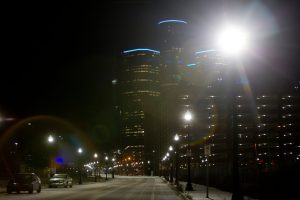
My sojourn next lead me to the People Mover, an infamous transportation folly that I felt obliged to experience. It was while riding up the escalator at the Fort/Cass station that I had the first taste of the eerie aesthetic of Detroit. The downtown is much like a 70s science fiction fantasy, what with an automated monorail that no one rides and the GM skyscrapers at the Renaissance Center, which seem like a lair of evil if there ever was one. Beneath Detroit’s drôle de métro, it seemed like the elite presided over a dystopian empire of misery. I certainly hope I don’t sound like a proponent of ruin porn, but I’m not trying to separate the city’s inhabitants from the changes in its built environment. Rather, this sci-fi-esque ambiance is a product of urban planning initiatives that sought to turn downtown Detroit into a safe haven for the elite completely separate from other residents of the hulking metropolis. The People Mover and skywalk systems seem designed to allow people never to have to set foot on the once mean streets of downtown, and any economic development professional can tell you this means less potential for small businesses to profit off of foot traffic. And the Renaissance Center doesn’t exactly invite pedestrians to enter after stepping off of a DDOT bus—I certainly felt uninvited as I attempted to cross Jefferson Avenue on a windy afternoon.

My first night in the Motor City concluded at Seva, a vegetarian restaurant behind a trendy gallery in Midtown, Detroit’s culture capital. As I nursed a glass of $3 rosé, I felt like Robert in French in Action as he nursed a kir in the Closerie des Lilas. I think part of why I continually felt a similarity between Paris and Detroit resided in the sense that both feel like places one goes to find oneself. Both are cities of great reputation, one famous and one infamous, but nonetheless places where it feels like incredible events are always on the brink of occurring.

I hopped on the 53-Woodward bus after dinner, and switched at the Grand Circus to the 18-Fenkell. Ford Field and Comerica Park were both nearby, and as I waited for the 18 I ruminated on what had led planners to place large temporal structures in the heart of downtown Detroit. It seemed as if in the great urban redevelopment efforts of Detroit planners had thought very “approximately” about the effect of projects. Sure, the People Mover certainly seems like it would attract riders since it goes to all the important downtown sights, but if every place it goes to is within a 10 minute walk why would anyone waste the time to take the train? Stadiums seem like they’ll revitalize a city since they attract large crowds, but they’re temporal structures, only serving their intended function for a small percentage of the time. Of course very few structures serve their purpose 24 hours a day (which is why planners prefer mixed-use developments these days), but any sports arena will be on the far low end, only attracting large crowds at very, very specific times, rarely for long enough to spur much by way of nearby development.

After a surprisingly restful night in the hostel’s group room, I started my morning off with breakfast at a coffee shop on Larned Street right under the People Mover. After some thoroughly mediocre over-medium eggs and a cup of hot, black coffee, I headed over to the Rosa Parks Transit Center, where I would dérive around the city, taking whatever bus line caught my eye. On a whim I eventually chose the 48-Van Dyke/Lafayette.

After leaving downtown, we passed by tranquil Lafayette Park, which my professor from freshman year (and esteemed urban planner in New York) Alexander Garvin had described as a truly successful towers-in-the-park project. It turned out Michel lived in Lafayette Park, and told me he would never reveal how little he paid for rent lest New Yorkers descend upon a too-good-to-be-true deal. Michel told me an older resident of Lafayette Park once told him that news of the ’67 riots didn’t reach the neighborhood until well after the fact. I commented that it seemed secluded and lacking much by way of commerce, and Michel agreed, but added that it wasn’t a problem since there were a few grocery stores within a few miles drive. Perhaps the rules of mixed development that have such profound impacts in walkable cities don’t quite apply in the kingdom of cars.

Soon the #48 bus entered the East Side of Detroit that is familiar to followers of the mainstream media. I suppose I would be rehashing to write in detail about the rows of empty lots, burnt out buildings, and high ratio of abandoned to occupied commercial structures. But one aesthetic element I found particularly captivating was the design of store signs: a good many of them are hand-drawn. Although these weren’t the districts conquered by the creative class, I was reminded of what Michel had told me about Detroit being a place full of creative freedom. In Detroit, land is cheap enough that people can start the kind of grocery store for which a whimsical, hand-drawn advertisement is more appropriate than computer-generated signage. These ideas were confirmed when I visited Heidelberg Street the following day.

The landscape felt absurd as we passed a stretch of Van Dyke adjacent to an almost completely-vacated district, not too far from City Airport. We paused at a railroad crossing, and everyone moaned as the lights started flashing and the arms came down. But a sigh of relief was breathed when the engine revealed itself not to be dragging a long train, but a single car. The ambiance of the moment and surrounding area made me feel a bit like I was in a Don Delillo novel; there was a certain absurdity to the colorful abandoned storefronts in the midst of empty grids and frequent railroad crossings serving ever-decreasing quantities of freight. I imagined a future in which the bus would pause for the passage of an engine carrying absolutely nothing. If planned shrinkage were ever to be politically feasible, I imagine some of these neighborhoods near the airport would be the first to go.

After my trip through the East Side, I walked through the Eastern Market, which sadly wasn’t open on a Tuesday, looking for somewhere to lunch. The deeply industrial feel of the area struck me. Huge trucks passed up and down Russell, and the sheds where the farmer’s market is held on Saturday were gargantuan. I was expecting to see the touristy sort of farmer’s market one finds in New York, which is more to offer the luxury of fresh produce than to serve any sort of utilitarian purpose. But Detroit’s Eastern Market is a powerhouse of commerce, a market to rival any of the greats in Taiwan or China.

I ended up dining at a Thai place called Sala Thai housed in the abandoned Fire House No. 5. After a quick Pad Thai, I went back to the hostel and then on a long walking tour of Woodbridge. Having wandered around the digital streets of Detroit on Google Maps before arriving in person, I imagined Woodbridge and Corktown as some of the most dangerous areas. They seemed to possess a great deal of urban prairie, and like a good student of Jane Jacobs, I posited this would mean fewer eyes on the street and thus danger. But something very strange has happened in a city shrinking as fast as Detroit: there are so few people in these districts that emptiness doesn’t mean danger. In that regard, it really is a lot like the countryside. Not to mention the clear lines of sight created by having empty lots in every direction.

When Michel told me what areas of the city to avoid, he explained that the parts generally regarded as most dangerous were those that formed a belt around the city. The far western parts of the city near Evergreen; the northern parts around 7 Mile and Dexter; and the eastern parts around Mack Avenue and Gratiot. Even a quick YouTube search on Detroit hip-hop will present one with rappers citing these neighborhoods as particularly infamous and dangerous to reckon with. One song is titled the “Linwood Dexter Way”; another simply “I’m from Seven Mile”; and there’s even a group called the “Gratiot Boyz.” But Woodbridge isn’t one of those areas a rapper would feel legitimate citing as perilous. A Buddhist temple and art galleries have felt comfortable entering the area, so I don’t imagine crime is at the kind of level where it becomes a daily concern in a resident’s life. The idea that what I’d dare call the least desirable neighborhoods (with a few exceptions, like the choice Palmer Woods areas) are in immediate proximity of the suburbs was certainly counter-intuitive to me. Cities very often disobey the notion of gradients one might expect to find.

My tour of Woodbridge concluded in Midtown, and as it was getting late, I stopped at Slow’s “To Go,” a branch of the famous barbeque joint whose ability to lure suburbanites to Corktown went as far as to attract the Times’ attention. I savored their delectable veggie chicken as I waited for the 16-Dexter bus on Cass Avenue. Of all the streets I saw in Detroit, I think Cass Avenue might have the greatest potential to be reborn as a vibrant urban thoroughfare. Its downtown portion offers sights of incredible architecture, like the dilapidated Hotel Eddystone. Up a little north, it passes by some quirky shops and a loft development on Canfield. Then you’ve got the university, the Detroit Institute of Arts (D.I.A.), and the Museum of Contemporary Art just a short walk away in Midtown, and the New Center at the end of Cass. I imagine other urban planners have had the same idea, since the Techtown incubator is located near the northern end of Cass. Combine all this with the street’s relatively small width, making it friendly to pedestrians, and pretty frequent transit service on the 16 line, and you’ve got a killer boulevard.

My last day in the D Michel gave me a tour of his favorite Detroit spots in his car, starting on Belle Isle and traveling through the Villages near the Manoogian Mansion. But he concluded his tour on Heidelberg Street, which remains my most prominent memory of this short adventure. For those unfamiliar with the Heidelberg Project, it’s the brainchild of an artist named Tyree Guyton, who came back to the neighborhood he grew up in after serving in the army during the Vietnam War only to find his neighborhood ravaged by the riots and ensuing neglect. And thus he unwittingly became one of the grandfathers of tactical urbanism, picking up a jar of paint and drawing polka dots on an abandoned house. Before long, he had transformed an entire street of abandoned houses into a tremendous art exhibit, and not one easily understood. The pieces range from the surreal to the deeply political, with human-sized fake syringes sticking out of the grass in one section, and stuffed animals overflowing from a house in another. Some of the project was destroyed by Coleman Young in the name of urban planning, but thankfully it still survives today, constantly changing with the whims of Tyree and the other artists who’ve collaborated on the Heidelberg Project.

To me, Heidelberg Street represents a deeply political reclamation of urban space, a willingness to take the built environment and make it represent the true feelings of a neighborhood, rather than paint over suffering in the name of improving the city. In the end, Heidelberg Street has achieved its artist’s goal of getting people to come into a neighborhood they once feared (and perhaps still fear), simply because it’s too original to miss. If it does contribute to the blight, which it may, its honesty makes it worth it.

I spent my last few hours in Detroit wandering up and down Woodward Avenue, taking in the much-celebrated Diego Rivera mural at the D.I.A. and visiting the old Fisher Theater in the New Center. I even stopped by a crêperie called “Good Girls Go to Paris” on Woodward Avenue, just for the sake of completing my French in Action fantasy.

At the end of the trip, I realized I wanted to write a piece about my experiences in the Motor City, capitalizing on the fact that I was there for a short enough time to have a feel for my visceral reactions—the emotions that would accompany a longer stay don’t cloud my vision. In my urban studies classes, I’ve found we as students have a tendency to confound the questions of how we do change a city in such-and-such way with how we should change a city.

They’re very different questions, and I think that at the end of the day planners should be concerned with how we do accomplish the feat rather than what feat we’re aiming for—that’s a decision for the citizenship. Thus I tried my very best to use my immediate feelings about Motown to guide my urban theory. If at the end of the day, Detroiters think the creative class is a plus for the city, simply because they expand the tax base, then that’s a decision they’ll have to weigh against gentrification. As a budding urbanist, my goal is to understand where each of these decisions may lead.

Alan Sage is an undergraduate at Yale University. He edits the Urban Collective blog for Yale’s urban studies organization.

Wednesday, April 4th, 2012

Detroit on Film

The power of “Brand Detroit.” I’ve talked about it many times. It’s the power of a city that draws the world’s attention. Not all of it good, but attention nevertheless. In a region of cities that all too often see themselves as lacking identity to themselves much less a brand in the world, Detroit stands apart. Like a Chicago or Los Angeles, the stories of Detroit overflow the page. This is a place with resonance. A place that matters.

One way this manifests itself is in the huge number of books, articles, photos, and films that have been made of the city. Recently Brewed Fresh Daily out of Cleveland pointed me at a Buzzfeed thread that had a collection of short films about Detroit. Some of these are longer than you might be used to watching in an internet video, but they are well worth checking out when you have the time.

Lemonade: Detroit

The first one is an inspirational video called “Lemonade: Detroit.” I’ll leave the description to the film maker:

Bad news is sensational. It’s the stuff of prime time exposés and gotcha news hours. People are attracted to bad news for the same reason they slow down past car accidents and watch horror movies: It’s impossible to turn away.

Thankfully, the same can be said for good news. Instead of sensationalizing blight, one new film will sensationalize hope. “Lemonade: Detroit” is about the disarming resilience of a city that is searching for an identity beyond a single industry, as told through the intensely personal stories of people who are actively reinventing the Motor City.

There have been far too many films about what’s wrong in Detroit. Far too many journalistic opinions claiming to offer hope that in reality glorify ruin. “Lemonade: Detroit” will make hope, optimism, and positivity as intriguing to watch as a train wreck.

Every character in “Lemonade: Detroit” is beating heavy odds placed on them by a world that expects failure. Documenting the struggle isn’t the point. Overcoming it is. These are the stories that must be told.

If the video doesn’t display for you, click here.

Real Scene: Detroit

Detroit has one of America’s richest musical legacies. The producers of this short film take a look at that history, focusing on techno, and especially on the scene around the music, not just the industry itself. Beyond the history, there’s also a bit of a look of what’s going on today. And it features a great soundtrack. If the video doesn’t display for you, click here.

Detroit Bike City

Here’s a pretty good video talking about Detroit’s bike culture. The thing I love about this one is how it shows the diversity of Detroit’s biking scene that goes well beyond the stereotypical hipster fixie rider. If the video doesn’t display click here.

Detroit Wildlife

This last one I had serious reservations about including because it is sheer exploitation – ruin porn in its purest form. It’s called “Detroit Wildlife” and it’s most reprehensible for the way it equates the residents of Detroit both with the ruins of the city and the actual wildlife found there. This was apparently a type of “demo reel” the film maker put together to raise funds to make an actual documentary called “Detroit Wild City” that I’ve not seen. I include it here to show what it is Detroit has become in the minds of too many outsiders. If the video doesn’t display for you, click here.

2 Comments
Topics: Urban Culture
Cities: Detroit

Wednesday, April 4th, 2012

Demolishing Detroit

The Detroit Free Press ran a story this week called “With so much space, so few options – Detroit’s vast vacant lots are a burden” highlighting the sheer scale of the vacant land problem in Detroit. As they note:

If vacant lots were painted red, an aerial view of Detroit would look like a bad case of the measles. There is so much empty land today within Detroit’s 139 square miles — land slowly returning to nature with no buildings — the city of Paris could fit inside. If all that land were gathered into football fields, Detroit could host 25,000 simultaneous games.

In recent years there have been ten times more demolition permits as construction permits, as this Free Press graphic shows:

h/t Chicagoist

Bonus Data Graphic: Real Time Wind Map

If you haven’t seen it already, Fernanda Viégas and Martin Wattenberg have put out a very cool real time wind map that shows the current winds streaking across the United States. Here’s a still of what it looks like. Click through to check it out.

h/t Likecool

Comments Off
Topics: Public Policy, Sustainability
Cities: Detroit

Tuesday, February 21st, 2012

The Reasons Behind Detroit’s Decline by Pete Saunders

My hometown of Detroit has been studied obsessively for years by writers and researchers of all types to gain insight into the Motor City’s decline. Indeed, it seems to have become a favorite pastime for urbanists of all stripes. How could such an economic powerhouse, a uniquely American city, so utterly collapse?

Most analysis tends to focus on the economic, social and political reasons for the downfall. One of my favorite treatises on Detroit is The Origins of the Urban Crisis by Thomas Sugrue, who argues that housing and racial discrimination practices put in place after World War II played a primary role in the decline of Motown. I’d argue that it’s closest to the truth of an explanation for Detroit today, but not quite there.

Everyone seems to know the shorthand narrative for Detroit’s fall. Industrial output declines; racial tensions rise. White residents leave; an unapologetic black leadership assumes control. And there’s quite a bit of truth to that narrative. Yes, the auto industry faced stiff competition, moved jobs to the suburbs, moved jobs down south, and later moved jobs out of the country. And all that happened with fewer jobs at each stop. Yes, Detroit does have a regrettably complex racial history and the legacy of two perception-forming riots since World War II (in 1943 and 1967). Yes, Detroit has had its share of political corruption, often tied to the tumultuous mayoral administrations of Coleman Young and Kwame Kilpatrick.

But here’s the thing. Buffalo and Cleveland have suffered the same kind of economic loss, but have not (quite) fallen to the same depths as Detroit. In fact, Pittsburgh suffered as much economically as Detroit, and is now poised for an amazing Rust Belt comeback. Any number of cities has had as troubled a racial legacy as Detroit, without being as adversely impacted. And Detroit certainly hasn’t cornered the market on political corruption, as long as Chicago exists.

So why has Detroit suffered unlike any other major city? Planning, or the lack thereof for more than a century, is why Detroit stands out. While cities like Chicago, Philadelphia and Los Angeles (don’t laugh – Detroit and LA essentially boomed at the same time) put a premium on creating pleasant built environments for their residents, Detroit was unique in putting all its eggs in the corporate caretaker basket. Once the auto industry became established in Detroit, political and business leaders abdicated their responsibility on sound urban planning and design, and elected to let the booming economy do the work for them.

Detroit’s decline has been going on far longer than most people realize, because of the city’s lack of attention to creating a pleasant built environment. Evidence? A Time Magazine article entitled “Decline in Detroit” from 1961 – yes, 1961 – had the following to say in its opening paragraph:

If ever a city stood as a symbol of the dynamic U.S. economy, it was Detroit. It was not pretty. It was, in fact, a combination of the grey and the garish: its downtown area was a warren of dingy, twisting streets; the used-car lots along Livernois Avenue raised an aurora of neon. But Detroit cared less about how it looked than about what it did—and it did plenty.

Emphasis added.

So what exactly did Detroit get wrong on the planning side of things? I outline nine direct and indirect planning and land use reasons for the Motor City’s current state. Here they are below.

1. Poor neighborhood identification. Ask a Chicagoan where they’re from, and they will likely give you a neighborhood name – Wrigleyville, Jefferson Park, Chatham. The same is true in other neighborhood-oriented cities like New York, Boston, even Washington, D.C. However, ask a Detroiter where they’re from, and they will likely tell you East Side or West Side; if pressed, they might note a key intersection. While the Motor City does have its share of traditional enclaves (Indian Village and English Village) and emerging hot spots (Midtown), Detroit is notable among large U.S. cities for having very poorly defined neighborhoods.

Neighborhood identification is important because ideally residents live in a neighborhood context. Schools, convenience shopping, social activities and recreational uses, all connected and shared by locals in a defined area, can provide a sense of community ownership. An argument can be made that’s been lacking in Detroit for decades.

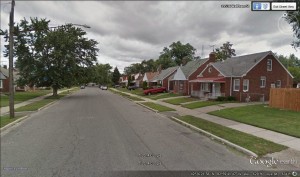
2. Poor housing stock. Detroit may be well-known for its so-called ruins, but much of the city is relentlessly covered with small, Cape Cod-style, 3-bedroom and one-bath single family homes on slabs that are not in keeping with contemporary standards for size and quality.

The general national perception of Detroit’s housing might be of a city that resembles the South Bronx in the late 1970’s – long stretches of dense but abandoned walk-up apartment buildings with a smattering of deteriorated single-family homes. The truth, however, is that Detroit may have one of the greatest concentrations of post-World War II tract housing of any major U.S. city. Two random images from Google Earth effectively demonstrate this. Detroit’s residential areas look pretty much like this, from the city’s northeast side:

Or like this, from the northwest side:

Note that these images come from the more intact parts of the city, not the “returning-to-prairie” areas that have brought the city notoriety. True, Detroit has more than its share of abandoned ruins that negatively impact housing prices. But it also has many more homes that simply don’t generate the demand that higher quality housing would. That is a major contributor to the city’s abundance of very cheap housing.

3. A poor public realm. Detroit’s streetscape is unbearable in many places. Major corridors have long stretches of anonymous single-story commercial buildings, with few trees or other landscaping. Signs, banners, awnings and decorative lighting are noticeably lacking. Overhead electrical wires extend for miles, and streets have been rigidly engineered with road signs and markings. The city’s corridors are hardly pedestrian friendly. Again, images from Google Earth can demonstrate this. Here is an area just blocks from where I grew up:

And another corridor a short distance away:

And yet another from the opposite side of town:

Even in a strong economic environment with fully occupied structures the visual appeal would be jarring. But this is Detroit, a city that has lost so much of the income and tax base needed to support the commercial areas and supporting infrastructure. That means empty buildings, broken sidewalks, poor street conditions, and a continuing spiral of decline.

4. A downtown that was allowed to become weak. Detroit did not always have a relatively weak downtown. The city’s core was a strong retail and commercial center through much of the 20th century, with the advertising, legal and financial offices that supported the auto industry. At some point, Detroit’s downtown became secondary as an employment center to the factory locations scattered throughout the city and metro area. Just like homeowners, offices began relocating to the suburbs. By the ‘60s more and more people saw downtown as a retail center as opposed to an office center, and one that could not compete with suburban malls.

5. Freeway expansion. This is something a little more familiar to planners when explaining the decline of central cities, but it’s acutely relevant in Detroit. I have no documentation to support it, but I suspect Detroit has more freeway miles per land area than most cities in the nation. The auto-dominated economy wanted a landscape that supported its values.

6. Lack of/loss of a transit network. Detroit had an elaborate streetcar network that was in existence until the 1950’s, but was largely replaced by buses. The auto industry took special interest in the conversion of the streetcar network to buses. General Motors lobbied the city’s Department of Street Railways (DSR) throughout much of the ‘50s, stressing that diesel-fueled buses were an effective lower-cost alternative to streetcars (no more rail maintenance costs!) and could provide much greater flexibility to meet shifting travel demands. Coincidentally, GM produced exactly the kind of buses that would easily facilitate the transition. By 1953, the DSR began a three-year effort to convert streetcars to buses, and the last streetcar route was completed in April 1956.

The kind of lobbying (coercion?) exhibited by GM happened in many other cities across the country. However, Detroit had no other alternative in place, like subways and elevated systems, in the way that New York, Chicago, Philadelphia or Boston did. Also, Detroit had no history of commuter rail reaching from the outer portions of the metro area to the downtown core, also like the afore-mentioned cities. And lastly, as demonstrated earlier downtown Detroit was already beginning its decline and was unable to be the kind of “pull” that would have supported alternative transportation uses there.

7. Local government organization. Another unique, if indirectly related facet of Detroit is its current local government organization. Like most major American cities of the late 19th century, Detroit elected city council members from districts or wards across the city. And like most of those cities, Detroit experienced its share of graft and corruption in the political arena. But the Progressive Movement that pursued local government reform throughout the nation had perhaps its greatest achievement in Detroit. In 1918, a new city charter was established that led to the reorganization of local government to have Council members elected city-wide, instead of by wards. This governance system has been in place ever since, but is slated to end with the establishment of a new charter in 2013 that will now elect council members from seven districts and two at-large spots.

This has been a double-edged sword for Detroit. While it may have kept a lid on some of the possible corruption that could have happened, it likely created greater distance between residents and city government. I believe this led to two significant impacts. First, it allowed the influence of the auto industry to travel unfettered within local government through the first two-thirds of the 20th century, without the countervailing influence of local residents. Second, without representation and support, neighborhoods were unable to mature in Detroit as they had in other major cities. They never had champions at the local government level, as elected officials had to view the city in its entirety and abstractly, and not represent and develop a unique part of the city.

The seven reasons outlined above would be enough to hurt the future development prospects of most cities. However, the last two reasons I cite, which look at land use actions and policy decisions from more than 100 years ago, are what distinguishes Detroit from any other city in America.

8. An industrial landscape that constrained the city’s core. A unique aspect of land use in Detroit that’s often discussed but rarely explored fully is the huge amount of industrial and manufacturing land in the city. It’s not surprising, really, since the city did give itself over to the industrial gods. Detroit was not only the home of the auto industry, but all the suppliers that made assembly there viable – producing everything from windshields to exhaust pipes.

Most cities across the nation, even most other Rust Belt cities, concentrated industrial lands in certain districts or corridors, often in just one part of a city. Usually the industrial lands followed waterfronts or rail corridors and connected with downtowns, and other parts of the city were spared the negative externalities of industrial use. But Detroit circa 1905 was faced with a critical decision – how could the city expand its industrial lands to capitalize on its emerging role as the Automobile Capital of the World?

To see how Detroit arrived at its solution one must understand the primary transportation system for manufacturing at the time – the railroads. By 1900 a dense network of rail lines had developed around Detroit. The principal lines that moved products in and out of Detroit, the Michigan Central and Grand Trunk Western, entered the city from the southwest and exited to the northeast, all just beyond the growing city’s limits. While numerous other lines existed throughout the city, the MC and Grand Trunk lines were critical because they connected Detroit with the rest of the nation. An article I found from the Railway Age Gazette, from June 1914, stated that:

The unusually rapid growth in the number and size of industrial plants along the main lines of the railways entering the city has caused serious congestion in practically all of the area within the city limits suitable for such development. (M)any railway and business men who had given the subject careful consideration were of the opinion that the only permanent relief was to be secured by building a complete outer belt line outside of the city limits.

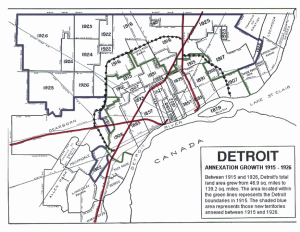
This is pretty well illustrated in the map below, with the Michigan Central and Grand Trunk Western lines highlighted in red. The city’s boundaries prior to 1915 are highlighted in green (please forgive my simple graphics):


Source: detroittransithistory.info website

Several railroad interests came together, including the Michigan Central and Grand Trunk lines, to address the issue of industrial expansion and congestion in Detroit. They elected to establish a new railroad – the Detroit Terminal Railroad. It was indeed an “outer belt line” that connected the Michigan Central Line with the Grand Trunk Western, arcing from the southwest side to the northeast, but also created a spur on the east side that would link to the Detroit River and allow for the development of additional industrial land. The DTR was constructed between 1904 and 1911. The line is illustrated on the following map with a dotted black line:


Source: detroittransithistory.info website

The land use dynamic changed when Henry Ford constructed his Highland Park assembly plant, which opened in 1908. In 1906 he bought 160 acres of land along Woodward Avenue in the small village north of Detroit, next to the crossing of the DTR at Woodward Avenue (the main roadway that extends through Highland Park in the above image). He was well aware of already-underway efforts to construct the “outer belt line” that industrialists had called for, and Ford put himself in position to benefit from it. Shortly after the opening of his new factory, an almost unbroken arc of industrial land lined the DTR – occasionally split by major arterial roadways that connected the city to its hinterlands, but largely occupied by the industrial supply and small assembly businesses that would serve each other. The DTR encircled and constrained the city’s dense urban core.

While it could not have been envisioned at the time, this led directly to another planning reason for the city’s decline:

9. Ill-timed and unfulfilled annexation policy. The two maps above show (in green) the city’s boundaries as of 1915. Bear in mind that Detroit’s population exploded from 205,000 in 1890 to almost 1 million by 1920, but not much new territory was added to the city during that time. In fact, between 1892 and 1905, the city did not annex any new land, all while rapid growth was happening. With the DTR now wrapped around the city with a wall of industrial land, city leaders began looking for new lands to annex to support the expanding population.

Huge annexations began occurring in the late 1910’s but accelerated during the ‘20s. This is purely my own speculation here, but my guess is that Detroit city leaders wanted to annex areas beyond the DTR arc to establish new neighborhoods for residents working in those very factories. That, I’m sure, was the plan.

Then the Great Depression and World War II hit.

Suddenly all the farmland that was supposed to be developed into new Detroit neighborhoods in the ‘30s and ‘40s was deferred by as much as twenty years. No new neighborhoods meant that the city core that existed in 1915 was essentially the same core that existed in 1945. Sure, a very strong demand for housing developed during that 30-year period, but tensions – race, management vs. union, among others – likely grew at an even faster pace.

The industrial wall and annexation policy had four impacts on Detroit. First, it created the push for suburbanization in Detroit, as residents sought to move away from the noisy, smelly and smoky factories that dotted the landscape. Secondly, the pressure to rapidly meet the pent-up housing demand in the ‘40s and ‘50s led to the vast spread of homes that today lack contemporary appeal. Thirdly, once industrial decline occurred it contributed mightily to the blight of the city as factories became abandoned – that’s largely how the city got its famed “ruins”. A pattern was established – industrial abandonment begat adjacent residential abandonment, which begat commercial abandonment, and begat even more residential abandonment. I would argue that the vast majority of vacant, “return-to-prairie” lands in Detroit are within a two-mile radius of the DTR. And lastly, the sheer amount of industrial land, with all associated cleanup concerns, made the decommission and consolidation of industrial land for other uses extremely difficult. Not that Detroit demonstrated the will to do so. There likely was a period during the ‘70s and ‘80s when the city could have effectively redeveloped industrial land to other uses, but again Detroit doubled down on the prospect of industrial jobs.

There’s an old saying that when you have a hammer, every problem is a nail. Granted, I am a planner, and I see planning problems as key to Detroit’s demise. While this point of view hasn’t been clearly articulated before, it’s clear that given this planning and land use legacy, it’s readily apparent how Detroit got to where it is today. Detroit’s problems began precisely with the rise of the auto industry during the 1900s and 1910s, not from the beginnings of its decline 50 years later or from ill-fated attempts to resuscitate it since. The seeds of Detroit’s decline had been sown long before suburbanization accelerated in the ‘50s, or racial tensions exploded in the ‘60s.

Detroit circa 1890 was a moderately-sized Great Lakes port whose economy revolved around shipbuilding and carriage-building. It was eerily similar in size, scale and character to Milwaukee at that time. But the work of Henry Ford, William C. Durant and the Dodge brothers altered that forever.

The rise of the automobile enriched the corporations and created the template for the expansion of the middle class around the country, but it transformed the city, to its astounding detriment. Left untreated, any improvement in Detroit’s economic, social or political fortunes would still leave the city with a troubled planning legacy.

Pete Saunders is a Detroit native who current works as an urban planner in Chicago.

Thursday, January 19th, 2012

Can Detroit Build Its Way Back to Prosperity?

If you look at the typical urban redevelopment efforts in any given city, they are heavy on capital expenditures. I’ve noticed quite a slew of articles on this of late related to Detroit: a light rail line on Woodward, a new bridge to Canada, a new transit station in suburban Troy, rebuilding and expanding I-94, $500 million in new hospital investment downtown.

But is this really the path back to success for a city like Detroit? Harvard economist Ed Glaeser noted in an episode of Smart City Radio, that “the hallmark of a declining city is that it has a lot of infrastructure relative to economic activity…it’s very strange to think that the right response is to build more structures in those places.” Challenged by host Carol Coletta about the need for certain new types of infrastructure or projects to attract educated people, Glaeser didn’t go for it, saying, “For every Bilbao that looks like a success, there are nine failures.” He didn’t say to always say No, but clearly favored low cost solutions like public art over big investments.

Anyone who’s been to Detroit knows that it’s vastly over-infrastructured and that the city and region can’t even afford to even to maintain what they have. Why then is so much of the civic effort put into new capex projects will only add new stuff that also can’t be maintained? Is this really the best use of funds? Keep in mind, the debt of the city alone is $20 billion. Even with private funds, there’s only so much money to go around.

Clearly, as things wear out, you need to repair and modernize them simply to serve the needs of local residents. The new terminals at Detroit’s airport fall into this category. Perhaps a road reconstruction would as well. So I’m not sure that a blanket “don’t build” is the right answer.

But I don’t sense that Detroit is thinking this way or coming to grips with the surplus infrastructure situation, excepting perhaps with abandoned housing. Rebuilding I-94 and improving interchange geometrics might be a good idea, but adding lanes strikes me as dubious. Detroit is probably over freewayed as it is, and with the city and regional population shrinking, I’m not sure building more roads is the answer.

Also, the focus on capital intensive transit like rail systems seems a bit crazy. Detroit is a highly decentralized metro area with greatly dispersed origins and destinations – exactly the type of place poorly served by rail. I’m not saying there’s anything intrinsically wrong with a rail line, but is that your best bang for the buck, and more importantly the best place to focus precious civic time and attention? Particularly when the city bus system is a shambles? Beyond which, Detroit’s strategies around things like rail and medical center investment are totally conventional wisdom, and don’t speak to the true character and needs of the city. Even if you get some people to sip lattes by the light rail on Woodward like they do in Portland, this isn’t going to change the civic trajectory.

The one thing that does strike me as strategic is the bridge crossing to Canada, as Detroit is the major trade gateway to Canada. But even this seems as much motivated, on both sides, by bad blood between local officials and Matty Moroun (owner of the existing bridge). And I’ve also heard that the real problem isn’t bridge congestion, but rather customs delays. A new bridge wouldn’t do anything about that.

I guess I’m a skeptic on Detroit trying to build its way back to prosperity. Particularly with the debt levels and the trouble the private sector has sustaining even existing amenities like the Detroit Symphony Orchestra. That’s especially true when it comes to “me too” strategies like light rail. I’m got getting a sense that much of this is in the service of anything that is uniquely Detroit or is rooted in the challenges of a shrinking city. Rather, it seems predicated on a “comeback” vision for Detroit seeking to recreate some semblance of former glory on the back of major capital investments. Has this worked anywhere?

However, the alternatives aren’t always that obvious. A lot of stuff really is run down and needs repair, replacement, or retirement. How to actually get rid of fixed assets is a tough challenge for a city. And new things do come along that can be important.

So I’m wondering what you think. How much should stagnant or declining cities focus on major capital investments? What types of investments, if any, should they make? What strategies would you suggest as a complement or alternate?

More Detroit
Detroit as Urban Laboratory and New American Frontier
The Other Side of Detroit
The Power of Brand Detroit
The Urbanophile Plan for Detroit
Yes, There Are Grocery Stores in Detroit

Wednesday, January 11th, 2012

Detroit: A City on the Move

Apparently this has been floating out there for a while, but architectural and cultural commentator Edward Lifson posted this fascinating 1965 Detroit promotional video called “A City on the Move.”

Update: Commenter Jim Meredith passed along a like to this Design Observer piece called The Forgetting Machine: A History of Detroit that you might find of interest too. And also a great photo essay of then and now photos called Detroit Re-Photography.

Part One (if the video doesn’t display for you, click here):

Part Two (if the video doesn’t display for you, click here):

I thought maybe I had posted this in this past, but couldn’t find it if I did. Apologies if this is a duplicate for you.

3 Comments
Topics: Urban Culture
Cities: Detroit

Tuesday, November 8th, 2011

Are Food Deserts Exaggerated? by Angie Schmitt

Much has been made of the food desert phenomenon afflicting the industrial Midwest.

GOOD Magazine, Dateline, NBC and countless others have weighed in on the apparent market failure that causes grocery stores to shun cities like Detroit and Cleveland like a bad case of head lice.


Detroit’s grocery stores, or food markets

This whole storyline reached a fever pitch earlier this year when it was widely circulated that the city of Detroit — all 140 miles of it — lacked a single grocery store. This was, of course, patently false. A quick Google search shows that there are dozens, even hundreds, of foodsellers populating Detroit’s neighborhoods.

What type of grocer does business in down-and-dirty Detroit? One example is the Honey Bee Market, a family-owned business that has been operating in the city for five decades. It carries a wide selection of Central American ingredients, in addition to plenty of fruits and vegetables. The store was voted “most fun” by Detroit’s Metro Times.

So how did the Wall Street Journal, Dateline and NBC get it so wrong about Detroit? I argue that it is all about semantics, along with a large dose of cultural relativism.

The argument about food deserts seems to be premised on the assumption that supermarkets — suburban-style, big-box, corporate chain stores with plenty o’ parking — are inherently superior to walkable, family owned food markets that serve low-income populations. The media portrays these corner markets as liquor stores or “discount” stores carrying little fresh produce and lots of Hostess cupcakes.

While there is certainly a class of convenience store that lacks healthy food options, many analyses have completely ignored the presence of small, family-owned food markets and their important role in feeding urban populations.

The USDA — which recently released its “food desert locator” to wide fanfare — admits to using “supermarkets and large grocery stores as a proxy for sources of healthy and available food.” Mary Reardon, a spokesperson for USDA said, “We define supermarkets and large grocery stores as food stores with at least $2 million in [annual] sales that contain all the major food departments found in a traditional supermarket.”

“We do not address smaller outlets that have fresh food,” she said. But she added that there are some local studies that have examined the issue. Here definitions are important. One of the two studies cited by the USDA [PDF] showed that depending on which definitions are employed, between 17 and 87 percent of New Orleans is a food desert.

To say that food sellers who do more than $2 million in business provide fresh food and those who sell less do not is a rough estimate to say the least. In fact, in my experience, it’s false. According to the locator, I live right on the border of a USDA-defined “food desert.” The thing is, I’ve never had better access to food in my life. The corner market by my house is exactly the type of place the USDA or CNN would ignore. The Deli, as it’s called, is kind of shabby looking from the outside and there’s no way it’s more than 10,000 square feet. But I love it.


The Deli in Cleveland is a small food seller, but it carries all the essentials. Photo: Angie Schmitt

It’s run by a family. They sell fresh-sliced cold cuts, fresh fruits and veggies. They have everything you’d need on a day-to-day basis, at prices I think are more than fair. I know because it’s helped me many times in a pinch. You can get eggs, potatoes, grapes, cheese (real cheese), sardines and even even pulpo (octopus) in a can. And of course you can also get essentials like band-aids, cheap beer, good beer, baby formula, toilet paper and macaroni and cheese. I have a recipe that calls for Jiffy corn bread mix and sour cream. They have them both.

It’s not the only market within a short walk from my house; there are literally half a dozen. There’s a Vietnamese market that I’ve grown to like for its unusual baked goods, selection of fish and exotic produce including escarole. There is Stockyard Meats, a family-owned butcher and general grocery, where you can order a whole pig for roasting. Right next door is a Save-A-Lot, which is a grocery in every other sense than the USDA/CNN definition. It’s no Whole Foods, but it has produce, meat, canned goods, frozen foods at prices that are appropriate for the neighborhood’s median household income ($25,000 at the last Census).

Just over a mile away is a “traditional” grocery store, by USDA definition, with a fish counter and a dairy aisle. It’s an easy trip by bike. But most of my neighbors, the low-income folks that that these types of studies are generally concerned with, don’t drive and don’t bother making the trek. And why would they? You can get everything you need in a short walk.

What the USDA fails to realize is that if food stores are located very close to your house, they needn’t be as large. You can pop in many times a week and pick up a light enough load to carry. That’s what many of my neighbors and I do. As a result, we don’t need SUVs. We don’t need acres of asphalt. Our neighborhoods are more livable thanks to corner markets.

What The Deli lacks in selection, it makes up for in accessibility. I’ll take walkability over 50 kinds of cereal and 14 kinds of peanut butter any day of the week.


Women haul groceries on foot in near west Cleveland. Photo: Angie Schmitt

As for the claim that that small food stores are unfairly exploiting their consumers, even the USDA’s analysis doesn’t support that conclusion. A 2009 study by the agency [PDF] found that those in the lowest income bracket (those that make between $8,000 and $30,000 annually) pay just 1.3 percent more than those in the next highest income bracket for food. Factor in the fact that many of these folks don’t need to pay for gas, car insurance and maintenance, and suddenly walkable food markets start to seem like a bargain.

Why does all this matter? The food desert problem, at least the way it’s been framed, seems to make a strong argument for cities to offer tax incentives for suburban-scale grocery stores to enter the city. Indeed the Obama Administration has offered $400 million to help expand food access in American food deserts. But if a big, corporate supermarket gets an unfair, taxpayer-funded boost, what will that mean for The Deli or Stockyard Meats?

There is a very logical, business explanation for why this hasn’t occurred already. The new grocery store would have to be within one-half mile to serve people who don’t drive, which is a significant part of the Cleveland market. The city simply doesn’t have the density to support so many large, walkable groceries. Instead, small markets fill that niche.

Without small markets like The Deli, food access and malnutrition would be a much bigger problem in Cleveland and many other cities throughout the United States. Rather than dismissing these businesses, the USDA should study these stores, how they make their stocking decisions and what room there is for improvement. Large grocery stores may offer a wide variety of fresh produce, but they come with a built-in deficit when it comes to accessibility for car-free people.

This post originally appeared in Streetsblog on May 10, 2011. Reprinted with permission of the author.

Tuesday, September 13th, 2011

Race Matters In Milwaukee – Part 1B: How Segregated Is Milwaukee? (con’t) by Nathaniel Holton

[ You can read Part 1A of this series here. ]

It turns out that Milwaukee is not the most segregated metro area after all.


Racial Map of Milwaukee


***

Racial Map of Detroit


(Both graphics by Eric Fisher)

***

The landmark report on segregation by the U.S Census Bureau published five measure of segregation. As previously discussed, this report ranked metro areas with a sufficiently large black population on how racially segregated they were. Then, the U.S Census Bureau averaged these rankings, and used that average to conclude that Milwaukee was the most segregated metro area in the country.

After all of the sophisticated statistical analysis that went into the production of the five segregation measures, it is surprising that the U.S Census Bureau would produce an overall segregation rank by averaging the segregation measure ranks, and not the measures themselves. As the following example shows, this distorts things.

Imagine three people whose wealth is measured in three different ways. You want to rank them in overall wealth by averaging their wealth from each measurement. In parenthesis below is the rank of how wealthy each person is compared to the other two people.

If you’re just averaging the money in each measurement, Aaron is the wealthiest person and would rank number one. But if you average the rankings, Brett’s average ranking (the average of 1, 1, and 2) is better than Aaron’s average ranking (the average of 1, 2, and 2).

Detroit is like Aaron. It has the worst segregation measures, but not the worst average ranking. Milwaukee is like Brett. We do not have the worst segregation measures, but we do have the worst average ranking.

When the segregation measures are standardized and averaged, Detroit comes out as the most segregated metro area in the country. Milwaukee comes out at number two. Here are the top five segregated metro areas using this way to measure:

The U.S Census Bureau may have had a good reason for going with their method. And, none of this changes the fact that Milwaukee is highly segregated, and that this remains a central challenge to our future. There’s little excitement in knowing that Milwaukee is “second only to Detroit” in yet another measure of socioeconomic health. At the same time, the stigma of being the most segregated place in the country is a damaging one. As it turns out, it’s not necessarily legitimate.

Sometime next year, the 2010 Census should be completed and we will be able to see how Milwaukee stacks up in segregation and many other areas. In the meantime, it is still important to look at the impact that segregation has on our health and our future.

This article originally appeared in The Milwaukee Drum.

Comments Off
Topics: Demographic Analysis
Cities: Detroit, Milwaukee
Tags:

Tuesday, August 23rd, 2011

Miriam in the Midwest by Miriam Fathalla

[ So a few months back I got an email from Miriam Fathalla. As crazy as this sounds, she was quitting her job as an urban planner in Melbourne (yes, Australia) not to move to back home to Portland, but to come spend a few months checking out the Midwest. She is now here, traveling to various parts of the region, and blogging about it over at Miriam in the Midwest, which I'd encourage you to check out. She also graciously agreed to talk about her project and some of what she's learned so far along the away. I hope you enjoy - Aaron. ]

Hi, I’m Miriam. I’m an American/Canadian citizen and an Australian permanent resident who has been living, researching and writing (www.MiriamintheMidwest.com) in Chicago since April, when I left my job as an Environmental Planning Officer at a Melbourne-area local government and moved myself, my curiosity, my Australian dollars and my post-graduate studies of Urban Planning and Community Development to an environment that would increase the value of these things: the American Midwest. I also kind of like run-on sentences. And fragments.

So why did I do all of this? Well, I’m intensely curious about people, their places and emerging and established social and economic structures in the American Midwest.

I have been following The Urbanophile for well over 2 years and the site’s analysis of the American Midwest coupled with stories about creative individuals and communities I found in Detroit Blog, Yes!, Ode, Good, New Internationalist, and New Geography inspired in me an increasingly strong attraction and curiosity about this thing called the Midwest, until it could no longer be ignored. As an American who hadn’t lived in the USA since 2004, I was curious to know what it meant to be an American anymore, I was frustrated by my fruitless attempts to turn my inspiration from reading these accounts into actions in my local area and I wasn’t entirely sure the Midwest existed (I kind of always thought it might be a Hollywood soundstage – like the moon landing). So, for these reasons I came to the Midwest to experience, research and write about emerging social and economic structures and discover what magic element was missing from my projects in Australia.

My broad, sweeping generalizing observations so far include:

People in the Midwest are young and fun.

As a 29 year old in Australia, I would go out with friends and often wonder where all of the people my own age were. But I have met many others in my age bracket with similar tastes and goals in Chicago and Detroit; even a handful that has also left professions to follow passions. This may be due to simply being in a larger urban environment or perhaps the stronger Australian economy and more conservative society is more conducive to twenty-somethings taking the house and husband path and American culture is more encouraging of independent and creative pursuits.

People in the Midwest are motivated.

The ambition, drive and energy of Chicago and Detroit are palatable. It’s not just willingness to work, it’s a desire to. Though this is likely connected to the elongated economic downturn of the area, especially compared to the currently surging Australian economy, this is none the less impressive. From Michael McDonald-themed dance parties to community learning structures to neighborhood parks to grassroots heat wave strategies (broken open fire hydrants), people are creating the elements of their society they wish existed. DIY isn’t just a scene here, a weekend pastime; it’s a way of life, the way of life of the Midwest.

This is likely due to the traditional middle-class nature of this society. I believe the proliferation of this mentality is a part of a wider social phenomenon that is being born out of shifting expectations of the government vs communities and I am excited to see this shift is not resulting in notions of competitive scarcity and increased social isolation but rather in creative and collaborative social initiatives and enterprises.

People in the Midwest can eat well.

Food is cheap. This may shock, offend or humor Midwestern residents, but compared to Australia food is definitely cheaper here. And I’m shopping and eating within the third largest American city – I’ve been told groceries are a lot cheaper in further outlying areas.

Stay with me, because this argument compounds.

The Supplemental Nutrition Assistance Program benefits (SNAP, colloquially known as food stamps) provides qualifying low-income individuals and families with a monthly credit of a minimum of $200 that can only be spent on food items. In my opinion, Australia’s social welfare system is more generous overall than the USA’s, however this type of benefit does not exist in Australia. Rental assistance, unemployment, parenting payments and baby bonuses are available but nothing that directly ensures residents have access to food is part of the Australian system. I think the American SNAP system is gold.

Since February 2011, the W.K. Kellogg Foundation’s “Double Up Food Bucks” program doubles the value of SNAP benefits used at many farmers markets in Michigan and Ohio. So, provided they can get to a participating farmer’s market, low-income residents are guaranteed access not just to food, but healthy, fresh and local produce. 

The program works by trading SNAP benefit credits for bonus tokens. This alternative currency can only be spent on produce from within the state, thus stretching consumer food dollars while supporting the local economy and local food producers. As an added bonus, the program provides experiential local food market education; participants can’t help but learn about what grows in their local environment and in what season as they seek out local growers and their goods.

Also, there is no good Mexican food in Australia* and I love burritos. I love them so much I almost stopped on my way from Australia to Chicago in San Francisco for a day just to get my fill. But then I realized that Chicago has a very high Hispanic population, and my love for my future city grew exponentially.

And then I tried a Chicago-style hot dog. 

And then I met the Tamale Guy.

Yes, I approve of the culinary culture of Chicago.

And it’s true that, portion sizes are enormous compared to those in Australia.

*I purposefully say this, hoping that some will be offended and make it their mission to prove me wrong when I return.

People in the Midwest are nice.

Yes my Chicago neighborhood is a far cry from my Australian home town of 300,000 where I often wouldn’t close, let alone lock my back door. Living on the western side of Humboldt Park, most people make a face when I tell them where I live, while I lovingly refer to my neighborhood as ‘vibrant’.

I’m on a relatively quiet one-way street a mini-block away from a major intersection but there’s always noise in the street. I consider it a lively buzz, the heartbeat that lets me know that there are others here with me. Right now I hear sirens, dogs barking, cars arriving and kids playing hide and seek. Often it’s someone(s) yelling in Spanish, ghetto beats and Spanish radio stations. They say you’re not really in Chicago until your bike gets stolen; count me as ‘arrived’ then. I’ve learned the difference between the sound of gun shots or fireworks from a couple of blocks away (but wouldn’t be stressed by hearing either), I see my neighbor dealing drugs on the street daily and the police patrol my neighborhood, but I wouldn’t want to live anywhere else.

Despite Chicago being the largest city I’ve ever experienced, I find the people here to be incredibly friendly. Not just polite, but actually ‘want to get to know you’, ‘help you with your groceries’ friendly. Chivalry is rife and I’m not complaining. I can truthfully say that every time I have gotten on a bus with others, men of all ages have stood back to let myself and other women board first.

I believe there are a number of compounding reasons for this:

  • Americans are generally more extroverted than Australians. However people in the Midwest seem to be friendlier than Portlanders.
  • In an undergraduate Urban Communication course, I discussed how Hispanic cultures can be found to be more extroverted than white groups (apologies, I’m having difficulty finding the exact reference). Chicago has a high Hispanic population. I’m not saying I’m only running into friendly Hispanic people, but that the strong influence of these cultures may affect how everyone acts here. (And I admit that I live in a predominantly Puerto Rican neighborhood so my experiences may have a certain bias.)
  • People are inherently good, creative and social creatures. I’m happy to see frequent examples of people bonding together to withstand hardships and create positive responses to potentially stressful situations. I have found that the lack of law enforcement in Detroit actually makes way for must more creativity than violence.

People in the Midwest are proud.

Okay, first of all Americans in general are proud. This is sometimes perceived as arrogant or haughty by others.

One of the first things I noticed upon my arrival was just how long it took to order breakfast at Denny’s. White/wheat, how do you like your eggs, what sides…  In Detroit I met a man who told me that he would purposefully ask for water with cucumber at bars just to prove that when asked what he would like, he should be able to be served whatever it is that he actually would like at that moment. 

I believe this proliferation of choice and the belief that we should have an abundance of options is a direct derivative of promise of American liberty. Australia does not have a Bill of Rights (and I was terrified when I discovered this). Considering how often references are made to this document, The Constitution and the rights and responsibilities these articles describe, it is clear to me that this absence would  affect the comparative culture of Australia.  However which is ‘better’ is of course impossible to say.  However a recent article in the New York Times is relevant to the discussion.

But Midwesterners are really proud. Proud of their country, their region, their state, their city, even their neighborhood and street.  I’m not really sure what is behind this, but I’m enjoying the scenery of t shirts, stickers and business names that proclaim hometown pride. And I admit that I’m getting sucked into it too.

When I share my new found love for the Midwest with others, pride of place is often reflected back at me. However sometimes it has been met with raised eyebrows and “You haven’t been here in the winter yet, have you?” 

I understand that the summers in Chicago are generally known for their magic, especially in relation to the city’s dastardly cold, bleak and isolating winters. Therefore it may be that the vitality of place I am currently experiencing is the annual aggregate energy of 8 million people condensed into a few hospitable months; however I won’t know for some time.

According to today’s travel bookings, I will leave the Midwest at the end of October. In the meantime, I am open to any suggestions regarding individuals, communities or organizations that are doing interesting things in the Midwest that lead to more connected, sustainable and healthy societies.

My goals are to document people’s stories and develop my understandings, while growing my network of community development, urban planning and design professionals and enthusiasts. I consider what I do ‘gonzo journalism and contemporary anthropology’ and my card says even says so. 

My research so far included pieces on group dance phenomena, placemaking, the last company town in the USA, community signage, informal street-level governance and more while I have articles on alternative food structures, community composting, crowd sourced funding, hometown pride, an underground library, alternative grassroots health care schemes, alternative housing, Detroit blogs, sustainable fashion and the general magnificence of Detroit in the works.

I have gone on “field trips” to Portland, Oregon and Detroit, Michigan and have more planned for Iowa City, Omaha, Wyoming, Winnemucca, Nevada, Burning Man, Provo, Utah, Moab, Utah, Colorado Springs, Colorado, Kansas City, Missouri, St Louis, Missouri, New York City, Los Angeles, California, as well as a return to Detroit).

Please feel free to contact me via my blog at Miriam in the Midwest with any questions, comments contacts or suggestions for further research.

Telestrian Data Terminal

about

A production of the Urbanophile, Telestrian is the fastest, easiest, and best way to access public data about cities and regions, with totally unique features like the ability to create thematic maps with no technical knowledge and easy to use place to place migration data. It's a great way to support the Urbanophile, but more importantly it can save you tons of time and deliver huge value and capabilities to you and your organization.

Try It For 30 Days Free!

About the Urbanophile

about

Aaron M. Renn is an opinion-leading urban analyst, consultant, speaker, and writer on a mission to help America’s cities thrive and find sustainable success in the 21st century.

Full Bio

Contact

Please email before connecting with me on LinkedIn if we don't already know each other.


Copyright © 2006-2011 Urbanophile, LLC, All Rights Reserved - Copyright Information