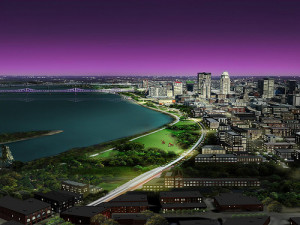
Tuesday is Louisville's mayoral primary. This is one of the issues that matter for the city's future. 8664 has published the results of a candidate questionnaire on their web site. Also note that 8664 co-founder Tyler Allen is running for mayor. If I still lived in Louisville, it would be a sure thing he'd have my vote! - Aaron. ] A few weeks ago, JC Stites, co-founder of 8664 invited me down to Louisville to talk about the proposal and take a first hand tour of the riverfront. Even as a Louisville native, I had never really walked around … [Read more...]
The Great Reset
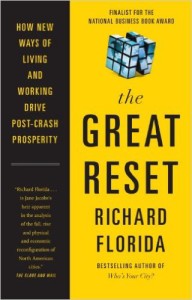
Richard Florida takes a lot of heat in certain quarters. As one of the most widely known economics writers, that makes some sense. Pretty much anyone who achieves a certain level of popularity acquires haters along the way. But most of the criticisms of Florida seem wide of the mark to me. Consider the one that he's in it for the fame and rock star lifestyle. Well, let's assume so. What's your point? Who doesn't want to be famous, or at least at some level well known in their field? I'll admit I'd like to be much more widely recognized that … [Read more...]
What Made Chicago’s Burnham Plan Successful
As part of my Burnham Plan centennial celebration, I was recently prompted to ponder what made this plan successful. (Let us put aside for future postings the question of whether it was in reality a success). I started creating a list of attributes of the plan I think contributed to its success. Interestingly, all of these are lessons for today's planners and are often overlooked. So let's consider some of them. 1. It was a private sector, business led initiative. I hear people today moan about the feckless political leadership in their … [Read more...]
This Is Sprawl
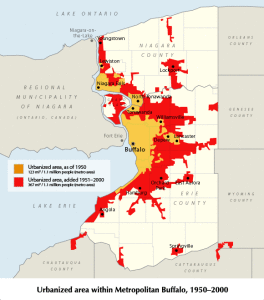
Sprawl is a word familiar to most people, but few can tell you exactly what it means. Even experts don't always agree on a precise definition. The term itself is somewhat ambiguous, and often divisive. This is especially true when the word is preceded by the modifiers suburban or urban, which is commonly the case. Then the term is really loaded. Political discussion of the topic regularly provokes the already contentious relationships between cities and suburbs. This needlessly causes communities that should be cooperating to take sides … [Read more...]
The New Look of the American Suburb
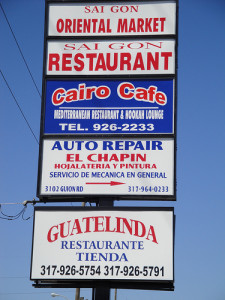
This article is about the intersection of two trends I've written about before: suburban redevelopment and immigration. If you want an easy demonstration of the unsustainability of the classic American suburb, just take a drive around the inner ring suburbs of almost any city, starting with the ones that have a classic branching, winding streets, not traditional grids or those that grew up along transit lines. It is easy to find untold miles of decay, of "dead malls", "grayboxes", and subdivisions that have seen better days. If most of … [Read more...]
True Cities and Shadow Cities
As many cities, particularly smaller industrial ones, continue to struggle with the loss of manufacturing jobs, people wonder how or if these places will come back and again become economically prosperous. I think the potential for economic renewal at least partly depends on whether or not a place is a true city or a shadow city. What do I mean by that? Here is one way I categorize the economic life of cities. One can divide companies into three types: Local goods and services. These are things like banks, grocery stores, dry cleaners, … [Read more...]
The Other Side of Detroit
That picture is of a house in the city of Detroit. Surprised? Don't be. Detroit actually contains numerous intact neighborhoods ranging from working class to upscale. These are seldom shown in the voluminous photo tours of the city that tend to focus exclusively on decay, and too often on the same handful of sites such as Michigan Central Station, a practice Vice Magazine dubbed "ruin porn." The decay is there. The collapse is real. That is the story. But it's not the whole story. Amid the truly legitimate and titanic struggles of Detroit … [Read more...]
The Outsiders
What does it take in a city to bring about change? I believe that one key prerequisite for change is a critical mass of outsiders; that is, a large enough of group of people who moved there without a background or personal connection to a place. Why? Outsiders are willing to imagine things being different in the first place since they already experienced and indeed grew up in an environment that is different. It's sort of like visiting a foreign country for the first time. We notice how all sorts of little things are different, prompting … [Read more...]
Replay: The Importance of Aesthetics in Transportation Facility Design
As I sat down to write a review of INDOT's nice 46th St. bridge replacement project in Indianapolis, it occurred to me that a sort of prologue was in order. I often talk about the importance of aesthetics and design identity in roadway design, but have to date not justified why that is something we should care about. I argue that there are national and regional trends that lead to this, especially in a Midwestern city. These cluster in three groups: Trends in international economics and culture Transformation of the public square in … [Read more...]
Downsides of Consolidation #2 – Cost Increases, Dilution of Urban Interests, Deferred Problems
This is the second and last installment in my mini-series on the downsides of city-county consolidation, or "big box" vs. "small box" government. Part one covers neighborhood redevelopment challenges. For those of you who didn't read that, I'm not opposed to city-county consolidations at all, and generally think they've been positives in places that have pursued them. I am merely examining some of the trade-offs that come with that choice. Like any form of government, this one too has its challenges. Cost Increases Proponents of government … [Read more...]
- « Previous Page
- 1
- …
- 29
- 30
- 31
- 32
- 33
- …
- 37
- Next Page »